Q: I’ve been tracking my food and counting my macros for about a year now. I’m loving the results I’m seeing, but weighing and measuring everything, counting calories and reading labels sometimes makes me feel a bit obsessive, even though I know I’m eating plenty. Do I have to track my food indefinitely?
A: Absolutely not! In fact, one of our goals for you is to learn to eat intuitively!
EM2WL doesn’t recommend calorie counting as merely a way of restricting food, but rather as a means to determine if you are eating ENOUGH! Using a calorie counter like My Fitness Pal can be a great tool for educating yourself about the calorie and macronutrient breakdown of different foods. It doesn’t take long to familiarize yourself with proper portion sizes and an understanding of setting up meals that will help you reach your macro goals by the end of the day. Many of our clients that begin tracking their food are surprised to learn they are eating far too little.
Photo credit: Stuart Miles
The ultimate goal of tracking food, however, is to trust yourself enough to eat intuitively, even without the security of tracking every macronutrient. Keeping a food log provides an opportunity to educate yourself about how to adequately fuel your body. After a short time period, you are likely to find the best way to set up your meals to reach your daily macronutrient goals. You will probably find what foods make you feel your best, and which foods you’d be better off avoiding or eating less frequently. You will probably find that for the most part, the staples of your eating plan are fairly similar from day to day.
If you’re used to keeping pretty accurate food logs, it can feel pretty overwhelming to make the journey to intuitive eating, but it’s well worth it in the long-term. Instead of an all-or-nothing approach, think about implementing small baby steps with the long-term goal being eating intuitively.
1. Keep a food journal, but don’t count calories
If you’re afraid that a break from logging will turn into an all-holds-barred eating fest, keep yourself accountable by keeping a food journal while you make the transition. Don’t worry about writing down amounts, but do jot down times and foods consumed, along with a few notes about how different meals make you feel. Are you satisfied after each meal? Struggling with emotional eating? Notice you don’t feel so hot after a particular meal? Struggling to get through workouts? All these observations can help you to make informed decisions about making a few simple tweaks to your eating plan.
2. Listen to your hunger and fullness cues
In addition to paying attention to how different meals make you feel, make sure that eating when you are hungry and stopping when you are satisfied, but not overstuffed. This may seem too obvious and simple to even mention, but for those who have spent a long time dieting, counting calories, and/or eating at specified times, it can be difficult to discern when you are hungry and full.
3. Log late in the day
Photo credit: Praisaeng
Another approach that can be helpful is to eat intuitively throughout the day and then check how you’ve done once you’re done eating for the day. You may choose to continue to weigh and measure foods during this transition, but remember the ultimate goal is to rely less on weighing and measuring foods and learn how to trust yourself to make decisions about food choices and portion sizes. It may be helpful to continue to weigh and measure “big ticket” items like fats and starchy carbs during this time, and eyeball things like lean meats, fruits, and vegetables since they have less potential to be overeaten.
The following rule of thumb might be helpful to remember:
Occasionally, after you’ve already portioned your food, check in with your digital food scale to make sure you’re still on track. Hopefully, you will be pleasantly surprised that your portion sizes are pretty spot-on! If not, a few days of getting back to weighing and measuring should get you back on the right track.
5. Take a short break from logging
If a break from logging food makes you extremely uncomfortable, consider taking just one or two meals per week off. Over time, you might be able to extend this time into a full day, and over time you are sure to find that you are trusting yourself more and more comfortable with eating intuitively.
Photo credit: lamnee
6. Don’t give up!
Be patient with yourself and forgive yourself if you run into some bumps along the road. Those things that are truly worth it in the end rarely come without a few obstacles. Ultimately, you are sure to enjoy the freedom you find from being able to eat intuitively. If you seem to be struggling to stay on track, you can always go back to logging for a few days. Remember there’s no time limit here and this is your journey! You can take as much time as you need to accomplish your goal. We look forward to hearing your success stories!
Becca is a busy mother five children ages 9 to 17. About seven years ago, she embarked on a journey to health and fitness that resulted in the loss of approximately 100 pounds. Today, she is a competitive powerlifter and strongwoman who loves ice cream and deadlifts. As an ISSA certified personal trainer, she is passionate about helping women to get started on a lifestyle of strength and fitness.
So I’ve sent in my success story before of my weight loss but I just thought I would follow up.
I hit my “goal weight” almost a year ago but when I hit it I knew I wanted more! Being 5’3 everything says I should weigh 130-140 so I’ve been trying for a year to get my weight down…during this time, I stopped counting my calories and tried to make better food choices by eating no processed food as much as I can but it slips in their here and there ;) I kept my weight training in and just recently added in a bit more cardio.
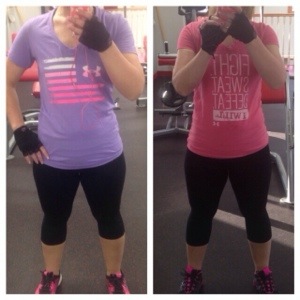
The scale never goes down, this whole time it only goes 150-155 and I’m so frustrated so I started meeting with a trainer and he’s been tracking my bodyfat, and in three weeks I went from 17% body fat to 16% and down 3.5lbs (of fat) but the scale has never moved. It’s been the same! That means I’m gaining muscle and losing fat! I feel so great and I finally believe that the scales LIE!!!! Here is a picture of only three weeks in which I went down in bodyfat percentage but not the scale.
I know how success stories keep me going everyday! Life struggles are always there and knowing the little things can push you through is what its all about!
Thanks ladies for all the inspiration!!!
Melanie
Have an EM2WL transformation to share? Willing to let us tag along on your journey? We’d love to see it! Be featured on our Transformation/Journey page by submitting your story to Success@EM2WL.com
Ever wonder why it gets harder and harder to lose weight? Or why you’re finally doing it the right way, but the scale just won’t move?
Dieting… Why is it so hard?
The more you diet, the less likely you are to lose weight – because you lose muscle and gain fat repeatedly — ultimately crashing your metabolism. Some studies have shown that for every 13 pounds lost on a traditional, low-calorie/high cardio diet, six pounds of muscle is lost. That’s almost HALF. In case you didn’t know:
Muscle = metabolism
This means that the more you lose, the slower your metabolism is. Then when (not if) you regain – you gain back FAT ONLY. Every time this process repeats, the fat percentage becomes higher than it was before, while muscle mass drops lower. So, even if you are the same weight you used to be, you’re technically “fatter.” If your weight is higher than it used to be, it begins to seem almost impossible to get the weight off. In some cases, it actually is impossible — if not futile — considering the loss of muscle mass and resulting metabolic crash.
After going through several diets, our goals must change. No matter how much you weigh – the goal (whether you realize it or not – your body does) becomes to “bulk” and build muscle to replace what was lost. Even if you ignore this fact, and attempt to start cutting the right way (eating a proper amount of calories and including some lifting) – your body still wants and needs to do this. When weight training during dieting – even if you’re in a deficit – you WILL gain muscle to replace what was lost. This means that you could sit at an extreme standstill on the scale, until your body has replaced every.morsel.lost… Remember that the scale does not tell the whole story.
Some women may only lose four pounds, yet drop two jean sizes; others may gain several pounds, and drop the same amount on the jeans. Although this is a more than nerve-wrecking experience, STAY.THE.COURSE. Because your only alternative, is to repeat the above course of action – and end right back at square one…gaining MORE fat.
Terrianne hadn’t seen any progress…based on the scale ;) ~Check out her story!~
Still not convinced? This study goes into extensive detail about how each diet leaves our body with less of the metabolism boosting muscle that we need. For those not interested in the 97 pages of details, here’s the meat: women will lose muscle naturally (23% in women between ages 30-70), if they do nothing to preserve it. Diet + cardio = muscle loss (68% fat, 22% muscle). Diet + LIFTING = 97% fat loss, and only 3% muscle loss. Big difference? We think so. When you truly grasp how the fat continually increases (while the muscle stays the same or lessens) between diets, you’ll understand how we diet all our lives, yet end up bigger. Doing it right is so hard to wrap our brains around, but I’d rather have 97% fat loss over 68%. How about you?
So…Is there any hope?
Many women hear of the harmful effects of the dreaded yo-yo diet and throw their hands up in frustration. They either decide that eating properly isn’t worth it, so they go back to overeating (drowning sorrows) or undereating (back to the diet comfort zone). With all this bad news, they feel despair over their hopeless metabolism, and reaching their fat loss goals.
There’s always hope!! You simply have to be JUST as patient with doing things the right way as you were with the quick fixes.
We’ve trained ourselves to have much more faith in doing whatever it takes when the process is quick. Yet our faith wavers when doing the right thing takes “too long.” It really becomes about not looking for the same measures of success that you have in the past, and not putting yourself on those same timetables. Something is always happening, but the amount of patience that we have, and stress that we put ourselves through will come into play. I tell clients that taking on fat loss in the right way – after years of doing it the wrong way – is like going to college. Every time you doubt the process and change something up (unnecessarily) it’s like changing your major mid semester — you add more time to your journey. More time is lost in this process due to the wavering of trust, than to the actual length of time it may have taken with a tad consistency. Add stress/cortisol to the mix, and it’s like taking a full semester (or two…or three) off. Stressing about your journey, and changing things up constantly to make things happen more quickly, usually hurts more than it helps. It never makes them actually happen more quickly (you either stand still or head backwards). Stay the course. Again – it’s tough, but the alternative is worse.
But what if you can’t lift?
Some clients feel hopeless because they have limitations that keep them from being able to lift heavy enough. We are not talking mindset limitations, like “I’m too old/young/fat/skinny, etc…” Those would be considered excuses, not limitations. But others of us may have actual physical limitations, or injuries (permanent or temporary) and doctors orders to not do certain movements. If this is you, you have to work with what you have. Not everyone can lift heavy. Heck, I (Kiki) couldn’t for the past year, due to injury. If the situation is temporary, then keep your protein in check, allow yourself to fully heal, and get back to it when you can. All you can do is the best you can do. Don’t put yourself at risk by taking on more than you can, and don’t put your metabolism at risk by eating less than you need. The healing process is worth it in the end. You’ll be able to lift soon enough (although I personally know how hard it is to wait).
If the situation is permanent, then much of the above still applies. Finding ways to add resistance that works for you will be your key. Just find ways of putting as much resistance on the muscle as you can to maintain what you do have. Feel free to contact us if you need help, putting together a personalized plan for your circumstances.
Feel like you’ll NEVER see changes?
Sometimes it’s really hard to see changes in ourselves that are so obvious to others. My husband, family and friends always see changes in me before I “allow” myself to. My first instinct is to deny that anything is happening until he says it about three to four times…or until someone else says it. Remind yourself to take compliments at face value. Most people have nothing to gain by telling you that “you look amazing” or “like you’ve lost tons of weight.” Instead of saying “no I haven’t” followed by some negative retort (because of your own inner scale struggle), train your mind to just accept that they likely see something that you haven’t allowed yourself to see yet. Take a few moments to allow the compliment to sink in — and remind yourself of it every time you cross paths with a mirror, until the next compliment rolls in (or you find a new one to give yourself).
Learn to see yourself as (or better than!) others do, rather than constantly being your own worst critic.
New to EM2WL?
Grab our FREE quick start guide!
Are you curious about how the process works, or wondering what's in our Starter Kit E-Book? START HERE. We'll send you a free breakdown of the basics, exclusive videos explaining why everything that you've learned about diets have only led you astray, and an action plan to take your life back immediately.
Trust me, as a busy momma of five children I understand that feeding a family, presents its own unique challenges. When you are working towards eating for your fitness goals, that can be even more challenging. And if you throw an food-allergic child or two into the mix, things really get interesting!
For years, I allowed these challenges to overwhelm me to the point that I figured there was no way I could possibly lose weight or become fit. I allowed excuse after excuse to creep in, and eventually just stopped trying. Years later, I came to a point where I realized that my excuses finally caught up to me. I had to make a way to embrace my challenges and succeed in the midst of them.
2010 – I’m smiling, but can remember dreading getting family pictures done because I hated the way that I looked. My life has completely turned around!
I’ve been at this for about three years now. After struggling to lose weight despite being on one diet right after the other, I learned that our whole family needed to embrace the changes that I was attempting to undertake. Fortunately, I am blessed with a great support system in my husband and children. Today, all of us are healthier, more active, and happier. Instead of looking at this like a diet, our whole family’s lifestyle changed.
Over the past three years, I have emphasized eating for different goals including powerlifting performance, weight loss, muscle gain, and fat loss. However, our family’s approach to eating has remained fairly consistent.
Below are a few things I’ve learned along the way…
Ditch the Diet Mentality
This sure doesn’t look like a diet to me! Big breakfasts are something our family loves to enjoy together.
There’s no reason that you should have to prepare separate meals for you and your children.
Even if you’re eating enough calories, preparing separate meals tends to make you feel like you’re on a diet. This feeling of mental restriction may actually trigger binge eating.
With a little recipe tweaking, even kid-pleasing family favorites like pizza, tacos and spaghetti can be included into your weekly meal rotation. Simple tweaks like adding a serving of protein, adding more veggies, or trying out a healthier twist on a recipe can ensure that you are hitting your macros. Get creative in the kitchen!
Have a weekly meal plan and stick to it
This can be as detailed as you want! To begin with, I’d recommend coming up with a list of weekly dinners. It may be helpful to ask for some input from your family as you are coming up with your list. I usually keep a list of meals on the refrigerator, and will sometimes ask my family which meal sounds best to them in the morning.
The good, the bad, and the ugly…a typical trip to the grocery store includes lots of whole foods, and plenty of treats too!
If you’re stuck in a cooking rut, you might check out our Pinterest boards for some healthy alternatives to family favorites. Your local library probably has some great cookbooks that you can check out for some new ideas. Trying out a new recipe once a week can be a fun family adventure, and may lead to coming up with some new recipes!
If you are home all day with young children, it may be helpful to come up with a list of breakfasts and lunches that they can select from. Keep some options for easy meals on hand, and as they get older, allow them some freedom to make choices and prepare their own lunches or breakfasts. It’s a great lesson in responsibility. As a homeschool mom whose kids seem to always be hungry, this has been a huge time-saver for me. Now that my oldest three are 13, 11, and 10, they are pretty self-sufficient and usually select pretty healthy meals for themselves.
After you’ve come up with your meal list for the week, make your grocery list so that you have everything on hand you need for a successful week of cooking (and eating).
Plan a day for food prep
After your trip to the grocery store, it may be helpful to do a little food prep make the cooking process a bit faster.
Since you already have all the groceries out, why not take a few extra minutes to think about the meals you have planned for the week ahead. It only takes a few extra minutes after you get home from the store to cut and bag fresh veggies, cook up and freeze some hamburger meat for soups and casseroles, or separate foods into single-serving containers.
I like to do this on grocery shopping day because there are already so many things to put away! I usually prep a few casseroles for the freezer to give myself some quick grab-and-go meals for those busy nights when I don’t have a lot of extra time. I also tend to cook extra meats, rice, potatoes , or vegetables when I am already cooking so that I can re-purpose the leftovers into a whole other meal. Thinking ahead can save a lot of time in the long run!
Don’t keep self-sabotaging foods in the house
At EM2WL, we are all about including all foods into your healthy eating plan. Nothing is off limits! That being said, however, many of us have foods that tend to be triggers to throw caution to the wind. It’s important for each of us to recognize our limits in this department. Keeping a lot of highly processed snack foods in the house “for the kids” may be a recipe for disaster if you are prone to occasional binges. Trust me, the kids will be okay without keeping them in the house. Help them to come up with healthier alternatives for snacks instead! Know yourself and your limits.
Involve your kids in the kitchen
Getting your kids interested in eating healthfully can be as simple as inviting them into the kitchen.
Even my youngest loves brussel sprouts…and dark chocolate chips too…OF COURSE!
Not only does getting them in the kitchen teach them math skills, responsibility, and nutrition, it can also be a fun time spent just with you. Even very young children can help measure ingredients, pour, and stir together a recipe. An older child can be taught to make an entire recipe by themselves and will get tons of satisfaction proclaiming they made dinner “all by myself”! Spending time in the Besides, they are much more likely to try something different if they have helped you prepare it!
Take the time to educate your children about the importance of including all kinds of foods as part of a healthy and balanced diet. These important life skills will serve them well their whole lives!
Don’t completely eliminate treats
Having a moderate and balanced approach to all foods, including treats, is an important part of any successful approach to eating.
Food is fuel, but it is also an important part of our family get-togethers and celebrations. Plan on including some mini-indulgences in your eating plan now and then.
Bake some cookies with your kids. Enjoy a cupcake guilt-free at your little girl’s birthday party. Have a few slices of pizza during family movie night. Enjoy the freedom to pursue your health and fitness goals without sacrificing your sanity! This isn’t a diet, but a lifestyle. Consistency matters! Make choices that allow you to win at consistency.
Becca is a busy wife and homeschooling mother to five children ages 5 to 13. About three years ago, she embarked on a journey to health and fitness that resulted in the loss of approximately 100 pounds. Today, she is a competitive powerlifter and strongwoman who loves ice cream and deadlifts. As an ISSA certified personal trainer, she is passionate about helping women to get started on a lifestyle of strength and fitness.
Once upon a time, working out at home was reserved for the Richard Simmons, Jane Fonda, leotard, thong, leg warmers, aerobics, aerobics, and more aerobics era. But with the explosion of Beachbody and other late night infomercials (are there other infomercials?) most of us have grown to accept a visual of more muscular looking individuals using dumbbells on our home workout screens. This new era of workout videos provides instant access to some of the top trainers of the industry today: Jillian Michaels, Kelly Coffey-Meyer, Jackie Warner, Cathe Friedrich, Chalene Johnson and so many more. The convenience of working out at home can be an amazing thing for the motivated individual, or the person who enjoys the “feel” of being in a class setting (minus worrying that one might be judged by classmates – gasp!! “can you believe she’s wearing those pink pajama pants?!”).
With the (over)abundance of workout vids, we might easily assume that ripped, superfit types (as seen on the videos) are also in great supply. If you are one of the growing number of at-home exercisers (like me), you may be – in fact – wondering when your ripped-ness will arrive. Or, perhaps you’re glumly thinking that you’re the only person on the planet who works your butt off with these annoyingly-ripped-freaks-of-nature, yet still look like you gave birth last week. Grrrr…How is it possible to work your buns off, yet still not be able to fit said buns into those skinny jeans? To collect bucket-loads of sweat from doing 30-Day Shred (for 120 days!), yet have no semblance of becoming “shredded” any time soon?
Whenever you can safely do so, increase weight.
This is typically because, as consumers, we tend to equate sweating with results. Moving nonstop during your workout, doing endless reps, or cardio moves between every lift will surely provide the sweat. Unfortunately, the amount of sweat that you leave behind has little to do with the reshaping of your body. As great as it feels, your body will eventually adapt to ANY workout that you do repeatedly, and you’ll stop seeing results. So should you toss your hopes of getting fit at home and run to the nearest gym? Not necessarily. It’s always great to work with what you’ve got (and I, for one, am not willing to shew my pink PJs just yet).
Here are five ways to make any DVD worth while:
Lift heavier
Make any DVD work harder by simply picking up a heavier weight. Even if you only have one or two DVDs to work with, increasing the amount of weight that you’re lifting is a quick plateau prevention/fix. Just because the people on the screen are using five – eight pounds doesn’t mean that you need to. Pick a weight that challenges you (ie. you can’t do MORE than two reps beyond the amount you’re supposed to be doing) and will bring you the results you’re after. Even if you come up a few reps shorter than “the crew,” you’re all good. Most home workout DVDs have far too many reps for the desired results. For strength gains, lift as heavy as you can for up to seven reps, for muscle building and definition lift for eight to 12 reps, and for endurance (cardio) perform 12+ reps (or as directed by the DVD). For best results, alternate all three rep ranges using weight appropriate for each range.
Train like a pro. Jot down exercises, weights, sets, & reps.
Take Notes
In order to have greatest success with the previous tip, be certain to take a moment to bring a pen and pad with you to the workout area. Jot down the exercises done in the vid, and how much weight you used. Whenever you discover that you could’ve kept going, put an asterisk or other symbol (like an up arrow) to let you know to go up in weight next time. ALWAYS lift heavier if you can safely do so. You’re not doing yourself any favors by using the same weight amounts for months at a time, no matter how much sweating is going down. Also keep track of how many reps you did, so that you can adjust the next time around. If you were able to do 12 pounds for 15 reps, then you know that you’ll need to go heavier if aiming for eight to ten reps next time around. Keeping a journal of your workouts (exercises, reps, sets, and rests) is key to a successful workout, whether at home or the gym.
Press Pause
It’s perfectly acceptable to press pause if the DVD is moving too fast (this will become incredibly relevant when increasing poundage for lifts). When doing circuit type workout vids (a weight move followed by a cardio move – or weighted moves with no rest between sets), it becomes ridiculously hard to lift heavy enough weights. This may tempt us to believe that we can’t go heavier, but this is far from the truth. While I would typically recommend doing a workout via a professional as written the first few times around, this becomes much less relevant the 88th time the video is done. It’s OK to stray from the pro at this point, and pause the dang thing, so that you can get some serious muscle involvement happening. Base your “rest” periods on the amount of weight and reps that you’re doing — just as you would in the gym — using the rep ranges discussed above. The goal of endurance needs very little rest (30 seconds or less) between exercises, muscle building requires slightly longer (30-60 seconds), and strength requires the longest (60-90 seconds). If the crew is doing 15 reps and you’ve chosen to do only six, then consider the “extra” time that they are pumping out reps as part of your rest period.
Moving too fast for you to lift heavy? Pause the dang thing!
Re-purpose “strength” DVDs
As mentioned earlier, most DVDs suggest dumbbells that are far too light, have too many reps, and not enough rest to be considered a true “strength” workout. No problem. Why not change the way that you view your vids and accept the faster paced workouts for what they truly are…cardio! Most so-called strength videos on the market are really just a glorified HIIT workout. So why not treat them as such. Metabolic cardio and HIIT are all the rage these days anyway, so using your old circuit workouts for cardio helps you to cash in on this trend. This also works well as an alternative for the person who can only make it to the gym a couple times per week. Plan your lifting days for when you have access to heavier equipment at the gym, and your cardio (via video) on the days that you can’t make it.
Swap out moves (or equipment)
Could you use a ball for pushups? Sub jackknives for crunches? Allow your mind to wander..
Let’s face it. Doing the same moves day in and day out for three years isn’t gonna “shape and tone” anything no matter how many times your DVD coach has told you so. Just as we get comfortable when we know what move is coming next on the DVD (or what words for that matter!) so do our bodies. And let’s just say that changes don’t happen when you’re comfortable…well, not good changes anyway. Now that you’ve been taking notes on your workouts (ahem?) you can use that same notebook to plot out ways to shake things up. Again, I don’t typically recommend taking a program written by someone who creates them for a living, and adding your own perceived “improvements.” However, if you know at exactly which pitch of the background song that a particular exercise will start…you stopped seeing results from that move many moons ago. There are safe swaps that can be done to most moves so that you are keeping with the general theme of the program’s intent. For example, you can sub the move for a variation of that same move: plie’ squat for regular, step ups or rear/side lunges in lieu of front lunges, hammer curls instead of traditional, etc..
You could also swap out equipment used in the vid, for equipment that you own but rarely use. I can’t count the amount of messages I’ve received from women asking if it’s “OK” to use hubby’s Bowflex, Nautilus, Smith machine, etc down in the basement…umm, YES! Don’t be scared to put someone else’s dust-collecting equipment to use – I did and it changed my life! The Gold’s Gym setup that I currently use in “Kiki’s Cave” is also formerly-known-as “Father’s Day Gift/clothes dryer” lol. Work with what you have. Teen son have an iron gym? Hubby have an old bench and rack? Score! Have some crazy as-seen-on-TV gadget that you just couldn’t pass up? Use. it. Variety is the spice of life, and just may help you get excited about working out to your old DVDs again. Sub out the old-is-new-again equipment for similar body-part movements. Bench press during pushups. Use a rowing apparatus (lat pull-down, rowing machine?) for bent over rows…or better yet, do pull-ups! Grab a Frisbee or gliding disc and do sliding lunges in place of regular. Use your Kettlebell in place of dumbbells, or sub Kettlebell swings (or sandbag cleans – see vid below) for another cardio move for circuit vids.
Take inventory of items you’d love to use, but never do, and allow your mind to wander. The possibilities are endless.
Not everyone can afford the time or finances that a full time gym commitment requires. Workout videos provide a convenient alternative for busy moms, housewives, or students that simply can’t make it to the gym regularly (or at all). With new formats popping up daily — whether via DVDs, downloads, or free sources like YouTube and Fitness Blender — you can make this growing trend work in your favor (and keep getting results!) with a few simple tweaks.
Do you workout with videos? What are your tricks for keeping the results flowing?





Recent Comments