
by EM2WL | Jul 7, 2014 | Consistency, Fat Loss / Cutting, Nutrition, Troubleshooting
 If you listen to the media, fat loss can sound pretty complicated. High carb, low carb, nutrient timing, intermittent fasting, carb cycling, ketogenic diets, carb backloading, juicing, green smoothies, magical supplements…
It can be challenging to keep a level head and avoid all the latest trends, wondering if a tweak (or two) might be a way to break out of a plateau or to get better results. There are definitely times to include a tweak, but generally speaking, its best that you save these for times that you really need them.
So how do you know if its time to include a tweak?
At EM2WL, we encourage you to take a very no-nonsense, simplified approach to fat loss with minimal rules. Instead of spinning your wheels to figure out which diet is best — take a moment to strip away the “nonsense” from various diet plans that are often just minute variations on the basics. There are a few best practices that we believe to be critical to your success. It’s best to make sure that these elements are firmly in place before tweaking anything.
Think about building a successful fat loss program like building a house. When building a house, you wouldn’t want to try putting up walls before the basic foundation has been laid. Without a firm foundation to build upon, everything else is pretty useless.
What makes up the foundation of a successful fat loss program? We believe there are four key components that are critical to have well established before incorporating any other “tweaks.” We recommend looking over your current fat loss plan and evaluating whether you have a good handle on the following four elements before making any additional changes. How do you measure up?
1. Sufficient calorie intake
 If you’ve been following EM2WL for some time, you know that we firmly believe that eating enough is a key component of a successful fat loss plan. The standard “eat less, exercise more” model of weight loss can lead to more muscle than fat loss, lowering your metabolic rate over the long term. Without eating enough calories, you run the risk of causing metabolic damage which does more harm than good. If you’ve been dieting for a very long time and are not seeing the results that you desire, it is very likely that you would benefit from doing a metabolic reset. If you are still struggling to get in an appropriate number of calories daily, it is highly recommended that you become consistent there before incorporating any additional changes. If you’re curious about how many calories is considered sufficient, check out our calorie calculator.
2. Protein
Not only do most women typically not take in enough calories, but tend to be lacking in the protein department as well. This macronutrient can be one of your biggest weapons in winning the fat loss game! Generally, we recommend taking in about 0.8 to 1.0 grams of protein per pound of body weight. A number of studies have shown numerous benefits to high-protein diets. Since protein takes longer for the body to break down and digest, it promotes a feeling of fullness, making it easier for you to stick to your plan. Protein also is essential in sustaining your lean mass, helping you to recover from workouts, and maintaining healthy skin, nails and organs. Protein also has been reported to improve brain function, lower blood pressure and improve sleep quantity.
It can be very challenging to get in all that protein! Give yourself time to get acclimated to a higher protein diet by setting reasonable goals and increasing them weekly. For instance, if your goal is to eat 150 grams of protein, but you’re currently averaging around 75 grams daily, you might start by trying to get in just 100 grams daily and increase slowly. Divide your protein among your meals, and it will likely seem a bit more manageable. Focus on making sure to hit your protein target daily, and then allocate the remaining calories to carbohydrates and fats.
3. Fiber
Most Americans only average about 15 grams of fiber daily, while most people should be taking in anywhere from 20 to 30 grams of fiber daily. Foods high in fiber are more filling and generally take longer to eat than foods low in fiber. They are a great way to “stretch out” your meals, thereby eating a high volume of food without adding many calories. In addition, including fiber in your diet will slow the digestion of carbohydrates and absorption of sugars, keeping blood sugar stable. High fiber foods also promote digestive health and prevent problems like constipation, hemorrhoids, IBS, and other digestive complaints. High fiber diets also promote heart health by moving fats and bile salts out of the body, lowering cholesterol in the process.
Tip: Yummy snacks like Quest Bars can provide 20g of protein, and 17g of fiber per serving. They can be helpful to reach your goals in a pinch, or if you’re newer to tracking these macros, but be sure to try getting as much protein and fiber from whole food sources as possible.
4. Heavy Resistance Training
Heavy resistance training should be a key component of any fitness program whose goal is fat loss. Heavy resistance training has a number of metabolic benefits that will pay off in the fat loss department. Unlike cardio, the metabolic benefits of this type of training last for 24-48 hours after completing your workout as your body must work harder to rebuild its oxygen stores. This effect, commonly referred to as the afterburn effect or EPOC (post-exercise oxygen consumption) has a number of metabolic and athletic benefits that will improve your body composition as well as your gym performance! If you don’t know where to start, there are a numb er of strength training programs to get you started on your journey to a leaner, stronger, healthier you!
If your current fitness program does not currently involve heavy resistance training at least 2-3 times a week, it is highly recommended that you start here before adding in cardio or other forms of exercise to accomplish your goals. You will be amazed at the way your body transforms when you consistently hit the weights!
DISCLAIMER: We know that many of our followers love running and other forms of cardio and we firmly believe that you should regularly engage in a form of exercise that you truly enjoy! However, there may be times to evaluate whether your preferred form of activity supports your goals.
The Take Away Message
If you feel that you have a good handle on these four elements, there is absolutely nothing wrong with making a small change or two to see how your body responds. We emphasize that it is usually best to change one thing at a time and give your body a chance to respond before changing another variable, however. As you make adaptations to your plan, you will want to make sure you are listening to your body! Pay attention to how you look and feel, how you are performing in the gym and your energy level any time you make a change. Often times, just a very small change can lead to some great results, but if you change too many things at once you will never know what that missing part of the puzzle was!
Photo credit: Apolonia, hin255 of www.freedigitalphotos.net

by EM2WL | Jun 30, 2014 | Building Muscle, Self Acceptance, The Journey
Perpetual diets often land us on a completely different path than expected. Many of us find ourselves on the frontline of Eating Disorder recovery, or fighting off the ED thoughts that a lifetime of dieting encourages. April shares a reflection of her mental journey with ED, an amazing encouragement for those still in the struggle.
 It’s been about two years since I met Kiki and Lucia and the EM2WL society. Two years since I started really listening to the advice given to me. Two years since I started fighting the false need to restrict and purge, two years since I threw out the 100-calorie meals and traded them in for what my body really needed, two years since I put down the baby weights and picked up a barbell.
It hasn’t been easy.
The summer of 2012 is when it all began, and I remember it so well. With the encouragement of EM2WL, I’d started to eat a bit more, quite a bit more, and lifting just prior to our summer vacation in Canada. I was still working out like a maniac, getting up at 5am for cardio and then following it up with weights after work. The idea of going to a foreign country without any specific workout schedule was debilitating. The weeks leading up to vacation, I had mini panic attacks that only slowed to a mild fear once my friend secured me a 3-day pass to the Y for our visit.
Also during those weeks, I started to bloat. The extra calories I was consuming (and needed) were throwing my poor body out of whack. My metabolism was such a mess from years of underfeeding it that my body had no choice but to bloat up. My children’s size 12 jean leggings were starting to get too tight, but I shoved myself into them during that vacation. I still fit into my double zero shorts, but barely, and I could see the bloat. I didn’t help matters by drinking a lot of wine that week and staying up late after everyone went to bed to binge on “healthy” snacks I’d brought with us. They were calories I needed, but I ate most of my calories all at once late at night along with a glass of wine. I was so tempted to purge, but I couldn’t since it wasn’t our house, and it was a small house. I would have been heard. I’d never felt so fat.
 Once we got home, we had a few weeks before our next vacation – a long weekend on Chincoteague Island. I spent the time detoxing and getting back into my workouts, and I started to feel a bit better. My body was still bloated, and I bought children’s size 14 jean leggings, but for the most part, I still thought I could fit into my double zeros forever. I was determined to do so. Somehow, despite the recent bloating, the four days on the Island were the last days I ever felt “skinny.”
Then we came home, and I started the New Rules of Lifting for Women. Now I REALLY gained weight. I still ate more and lifted heavy, and I was forced to face facts: I would have to buy new clothes.
Over the next year or so, I pretty much hated myself. I’d spend nights binging and sometimes purging. I stuffed my body into clothes that were too tight, praying for my weight to drop. I played with the idea of restricting again, and occasionally, I gave in. Sometimes I changed my mind about lifting and went back to cardio, but nothing changed. Throughout it all, Kiki and Lucia and a handful of others stuck around. They listened to my complaints and encouraged me to keep pushing forward. They filled my head with more and more knowledge about how to eat and what was happening to my body and why lifting is so important.
Eventually, I bought clothes that fit and started to feel marginally better. Gradually, I learned what kinds of workouts my body could handle without destroying my mental state. I finally stopped killing myself with 2 workouts/day and limited most of my cardio to HIIT (albeit LONG HIIT) and hid my scale away which made a HUGE difference in the way I felt about my body.
 I can’t pinpoint the exact date or even the exact month, but at some point during 2013, my metabolism evened out. The bloating disappeared. I was still heavier and larger than I’d been during most of my late 20s, but I started to have “sleek” days. I started to enjoy lifting and to rejoice over the NSVs.
I can confidently say that 2014 has been the best year of my life in all the ways that matter. I’m learning about lifting phases and how to plan my workout rotations to keep my body guessing. I no longer stress my body with long HIIT or steady state sessions which means more time with my family. I FINALLY allow my body 2 days of rest each week, and to my surprise, that small change filled me with such relief! It was as though I was finally giving myself permission to sit back and enjoy those weekends without the stress of choosing a workout and trying to burn calories. Most days, I feel great!
I still stress sometimes over calories numbers – calories burned during workouts and calories consumed. I still have my “yuck” days, and I am still TERRIFIED to take a full rest week during vacation this year!
But I’ve learned so much over these past two years and come so far, it’s hard to believe I’m the same person. I no longer look at the pictures of myself when I was 90 pounds and yearn to be that small anymore. I’ve thrown out all of my double zeros and don’t even care what the number on the tags are when I go shopping for new clothes. I have everything from small to large, from 4 to 9, and I just don’t care anymore so long as it fits well and looks good. I’m more confident than I’ve ever been. I’m talking my entire life. I still have the parts of me I’d like to make better, but for the most part, I’ve given up the comparison to other women and the self-name-calling. I’ve given up looking at myself every day and walking away “knowing” I am fat. Because I’m not. Because I’m strong and fit and healthy and beautiful. I don’t feel that every day, but I almost never hate myself.
I could never have gotten here without all of you. Never. Thank you all so much for your love and support, for encouraging me through this journey rather than giving up on me. Here’s to the journey, no matter how tough. The end is nowhere in sight, but possibilities are endless.

Strong and fit!

by EM2WL | Jun 27, 2014 | Main Dish, Recipes
In our family, summertime (or really any time for that matter!) is grilling time. The other night, we made these awesome chicken bacon skewers and they are UNBELIEVABLY good for being such a simple recipe.
Smoky Chicken Bacon Skewers
Make these chicken kabobs for your next barbecue. Guaranteed to be a crowd pleaser!
Ingredients
- 3lb Boneless, skinless chicken tenders (or chicken breast cut into chicken-tenders type strips)
- 1lb Bacon
- 1/2 cup Barbecue sauce
- 1/2 cup Asian-style vinaigrette (I use Bolthouse Farms)
- 1 tablespoon Garlic (crushed)
- 1 tablespoon Smoked paprika
- 1/2 tablespoon Chili powder
- 1 teaspoon Salt
- 1 teaspoon Black pepper
Directions
|
|
| In a large bowl whisk together barbecue sauce, vinaigrette, garlic, paprika, chili powder, salt, and pepper. Pour into 9 x 13 pan. Set aside. |
|
|
| Thread chicken tenders onto skewers. Wrap bacon around chicken and secure ends. |
|
|
| Place skewers in pan and cover with marinade. Allow the bacon-wrapped chicken to marinate for about 4-6 hours. |
|
|
| Grill the skewers on low heat for about 20 minutes. Then move to high heat and finish grilling to crisp the bacon, about 5 minutes. |
Note
We like to serve these with grilled veggies (sweet potatoes, baked potatoes, and zucchini). Such a simple and delicious meal!
Makes 12 skewers. Nutrition facts per skewer: 202 calories, 3 g carbohydrates, 10 g fat, 26 g protein
Becca is a busy wife and homeschooling mother to five children ages 5 to 13. About three years ago, she embarked on a journey to health and fitness that resulted in the loss of approximately 100 pounds. Today, she is a competitive powerlifter and strongwoman who loves ice cream and deadlifts. As an ISSA certified personal trainer, she is passionate about helping women to get started on a lifestyle of strength and fitness.

by EM2WL | Jun 5, 2014 | Building Muscle, Cardio, Fat Loss / Cutting, Nutrition
Q: I’ve been lifting for about a year. I love my time at the bar, but I’m frustrated by my lack of progress! I see my training partner’s lifts going up consistently, but I can’t seem to push past plateaus! What am I doing wrong?
A: There are a number of possible explanations why you may have hit a plateau with your lifts. Be aware that almost everyone reaches a point where their lifts have stalled, but usually, when your lifts have stalled it is a good sign to look at your programming and determine if a small tweak or two could help.
It’s also important to remember that those new to lifting will make very quick progress regardless of what program they are following. After a few years of lifting however, it’s important to pay closer attention to the details.
Below are a few of the reasons why your lifting may have stalled.
1. Trying to lose fat (cals/carbs too low)
After you get past the stage of newbie gains, it is very difficult to gain strength while in a caloric deficit. You will probably find that you are able to consistently increase strength, gain muscle and lose fat (albeit very slowly) eating closer to your maintenance level calories. This isn’t to say that it can’t be done, but you will probably want to pay very close attention to nutrient timing, making sure to take in plenty of carbohydrates pre- and post-workout.
When trying to lose fat, many tend to view carbs as “optional.” However, if you are desiring to increase strength, cutting out carbs is not the wisest idea. Carbohydrates are your body’s preferred source of energy for intense workouts. Furthermore, when carbohydrates are adequate in the diet, it spares protein from being used for energy, and protein can do its job-build and repair muscle tissue.
When starting a cut, it’s best to decrease carbohydrates and calories very slowly, keeping an eye on your training and the way that you feel and tweaking things accordingly. If you are consistently feeling very run down and missing lifts in the gym, you may want to consider increasing your carbohydrates and possibly cutting back on the amount of fat that you are taking in.
Generally, slow-acting carbohydrates(sweet potatoes, whole grains, and low-glycemic fruits) are best consumed about 30 minutes to an hour prior to your strength training session. This will provide enough time for digestion so that you don’t go into your workout feeling overstuffed. Fast-acting carbohydrates (white potatoes or rice, foods high in sugar, or high-glycemic fruits) are best taken in during the hour after training.
Following an intense strength training session, your cells are depleted of both glucose and glycogen. Cortisol levels are also elevated. Fast-acting carbohydrates cause an increase in insulin levels, which in turn can cause greater muscle growth, when timed appropriately. When consumed, simple carbohydrates can be stored as glycogen, which is the primary source of muscle “fuel” during intense training sessions.
Post workout, elevated insulin levels allow muscle to better utilize stored glycogen for recovery and growth. This also helps cortisol levels to return to normal levels following an intense training session.
Don’t fear carbs, but learn how to use them to complement your training!
2. Too much emphasis on endurance activities
Another common mistake that strength trainers, especially women, make is of doing too many reps, too much cardio, and too many exercises that fatigue the smaller muscle groups. If your primary goal is to gain strength, you will want to keep your reps low and your weights high (3-5 reps at 80-85%1RM) on compound movements. Always do your compound movements (squat, bench, deadlift, rows, and presses) first, and use assistance work as needed to bring up weak points and provide an environment for hypertrophy. Assistance work should still be kept in the range of 8-12 reps for 3-5 sets. If you are able to do more than 12 reps, it is probably a good idea to increase the weight.
Cardio is a question that tends to come up frequently. A lot of women are okay with incorporating some strength training into their workout rotation, but panic at the thought of cutting back on or eliminating cardio. However, if your primary goal is to increase strength, too many endurance activities (i.e., steady-state cardio) can detract from the strength gains you are wanting to see.
If you still want to include some cardiovascular training into your workout rotation, the best scenario would be to add in some short (4-12 minute) metabolic finishers at the end of your strength training sessions. A metabolic finisher is an intense exercise or circuit of exercises designed to increase your body’s fat-burning potential by increasing the “afterburn effect” by increasing the number of calories burned as you recover from your workout. It speeds recovery by returning blood flow to the muscles and improving all-0ver conditioning and athleticism.
Good options for metabolic finishers include heavy kettlebell swings, tire flips, various forms of weighted carries, barbell complexes, sprints, prowler/sled work, and body weight exercises.
3. It’s all in your head
Sometimes, we are our own worst enemy to making progress. If you’re going for a PR, there should be no question in your mind that you will finish the lift. If you approach PR attempts with a fear of failing or a less than confident approach, chances are you will hinder any forward progress.
When you are going for a PR attempt, you must be completely confident as you approach the bar. Training with good spotters that you trust is crucial as you train with very heavy weights, especially as you go for lifts that are near 100% 1RM. There is a time and place for training to failure, but generally speaking, you will always want to end your training session successfully.
If you have any doubt in your mind that you won’t finish a lift, save it for another day.
4. Under- recovery between sets/training sessions
Another common mistake is failing to recover adequately, either in between sets or in between training sessions. It’s critical that the length of your rest periods lines up with your goals. Since it requires about 3 minutes for phosphagen stores to be replenished, 3 minute rest periods are probably most optimal if you are training for pure strength.
Full recovery will allow you to generate the most muscular power for each set, making each set as effective as possible. If you are training for pure strength, slow down in between sets, sip water, and get mentally refocused before beginning your next set.
Make sure that you are taking adequate time between training sessions to recover as well. A good rule of thumb is to take about 48 hours recovery in between intense training sessions. However, you can train opposing body parts on consecutive days (upper body on Monday, lower body Tuesday, rest Wednesday, upper body Thursday, lower body Friday). Make sure that your rest days are truly restful.
In addition, you will want to make sure that you are taking in plenty of high quality food, sleeping well, and keeping stress levels as low as possible to maximize your recovery time!
5. Attempting too much, too soon
It’s important to make sure that the strength goals that you have outlined for yourself are reasonable. Attempting to increase too much weight too soon will most likely result in injury, frustration, and breakdown in form.
Choose a solid, periodized program and determine to stick with it and trust the process! Training with sub-maximal weights will get you stronger over time. On a similar note, testing training maxes too often is extremely taxing on your CNS and will make recovery in between training sessions much more difficult. Focus instead on setting rep PRs, and leave training maxes to once every 4 weeks, at most.
Generally speaking, a reasonable expectation would be to see lower body lifts increase by about 10-20 pounds and upper body lifts increase by about 5-10 pounds over a 8-12 week period of time, provided you are being consistent in your training and paying attention to your nutrition. It may not seem like much, but over time, you will be amazed at your progress if you can learn to be patient with small strength gains.
6. Same old, same old
Our bodies are very good at making adaptations to the stressors that we place upon it. In order to continue to make progress, it is important to switch things up every once in awhile.
If you’re stuck at a strength plateau and have been following the same program or rep scheme for over 12 weeks, it is probably a good idea to switch things up. If you’re used to training in the 8-12 rep range, you may switch to a 5 x 5 for awhile and work on increasing your weights. If you’ve been training with heavy weights and low reps for awhile, you may benefit from an increase in volume. Varying your assistance work is an other great way to keep your body challenged!
However, a word of caution: make sure to change one or two things at a time and stick it out for a minimum of 8-12 weeks before changing another factor. It’s very important to make small changes and make careful notes about what is working. If you change too many things at once, you will never know what’s working!
7. Bad technique
Take the time to learn proper form, especially on the three big lifts (bench, squat, and deadlift). Always train to a full range of motion, and you will get the maximum benefit from each rep and set. If you are unsure about proper form on these lifts, you might benefit greatly from setting up an appointment to meet with a personal trainer, or watching instructional videos on Youtube. Start with the empty bar and be patient with yourself. Once you learn proper technique, it will become easier and easier to add weight to that bar and see the strength gains you desire!

by EM2WL | Apr 29, 2014 | Self Acceptance
At EM2WL, we believe whatever your fitness goals, you should enjoy your journey and celebrate the moments along the way where you are achieving small victories.
 Nothing can rob you of that joy more than comparing yourself to others.
Daily, we are blasted with messages from social media, blogs, and even friends and family regarding fitness. We are wise to be on top of our mental game by eliminating messages that will cause us to second-guess the journey we’re on. Surrounding yourself, as much as possible, with like-minded people is a great way to keep you moving forward and motivated.
However, its easy to look at those that motivate us and begin to wonder why we aren’t experiencing the success they are. We can move rather quickly from thoughts like “Wow, look at her, she’s doing great and I’m so happy for her!” to “I wish I had that kind of success, but I’m obviously doing something wrong.” We start to nit-pick the path we’re on, and pretty soon we’re convinced that if we did x, y, and z like so-and so, we would be able to manufacture their success.
Listen, everyone is different. Each of us has a different set of genetics, metabolic capacity, and body type. Beyond that, each one of us experiences different life circumstances. Stress can add in an additional variable to manage. Even if you were able to follow your best friend’s diet and exercise plan to the letter, you would get different results. Comparing yourself to others can only introduce an additional stressor that can do more to hinder than help your progress.
 Understand that fitspo is not real
We’ve all seen them, the pictures of super-ripped (read: unrealistically lean) headless females with some saying that is meant to motivate the masses…
Strong is the new skinny
Eat clean, train dirty
When I lost all my excuses, I gained all my results
Try harder, you’re worth it
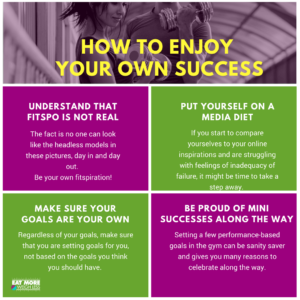
You get the idea. Gag me. Apparently a picture of a headless chick in a thong and heels doing deadlifts are apparently supposed to motivate us to swear off carbs for the rest of our lives, train so hard we feel one step away from death at the end of our workout, and finally lose all that weight so we can prance around night and day in a bikini. The fact is no one can look like the headless models in these pictures, day in and day out. Some serious photoshopping goes into most of these pictures. Even those models that really do look like those pictures only do so for a short time because it’s very unhealthy and unsustainable to carry such low levels of body fat. Getting a physique like the models in these pictures is generally the result of an extremely restrictive, short-term diet, not a healthy lifestyle. See them for what they are. Be your own fitspiration!
 Put yourself on a media diet
It’s not just the fitspiration that’s the problem. Even if we are careful to surround ourselves with a “fit fam” who shares the same mentality and goals as we do, it can be easy to get sucked into the comparison game. Try to limit your time online. If you start to compare yourselves to your online inspirations and are struggling with feelings of inadequacy of failure, it might be time to take a step away. Make sure that your life is about more than your fitness goals! There is a considerable amount of time that goes into planning out meals, scheduling workouts, and training in the gym, but don’t let it become your sole priority in life. Make time for the things that truly matter-your friends and family, your significant other, your spiritual life, rest, relaxation, a personal hobby.
Make sure your goals are your own
Regardless of your goals, make sure that you are setting goals for you, not based on the goals you think you should have. Think about what achieving your goal will mean to you personally and what it will require for you to achieve that goal.
Be proud of mini-successes along the way
Remember that this isn’t a sprint, but a marathon. There are sure to be ups and downs along the way, so make sure to check in frequently with yourself. You may or may not have a goal weight or goal size, but try to set up mini-milestones along the way that are sustainable and achievable. Setting a few performance-based goals in the gym can be sanity saver and gives you many reasons to celebrate along the way. You never know, you may find that achieving that elusive goal weight was never the real goal anyway.
 Becca is a busy wife and homeschooling mother to five children ages 5 to 13. About three years ago, she embarked on a journey to health and fitness that resulted in the loss of approximately 100 pounds. Today, she is a competitive powerlifter and strongwoman who loves ice cream and deadlifts. As an ISSA certified personal trainer, she is passionate about helping women to get started on a lifestyle of strength and fitness.
Plugin by Social Author Bio

 If you’ve been following EM2WL for some time, you know that we firmly believe that eating enough is a key component of a successful fat loss plan. The standard “eat less, exercise more” model of weight loss can lead to more muscle than fat loss, lowering your metabolic rate over the long term. Without eating enough calories, you run the risk of causing metabolic damage which does more harm than good. If you’ve been dieting for a very long time and are not seeing the results that you desire, it is very likely that you would benefit from doing a metabolic reset. If you are still struggling to get in an appropriate number of calories daily, it is highly recommended that you become consistent there before incorporating any additional changes. If you’re curious about how many calories is considered sufficient, check out our calorie calculator.

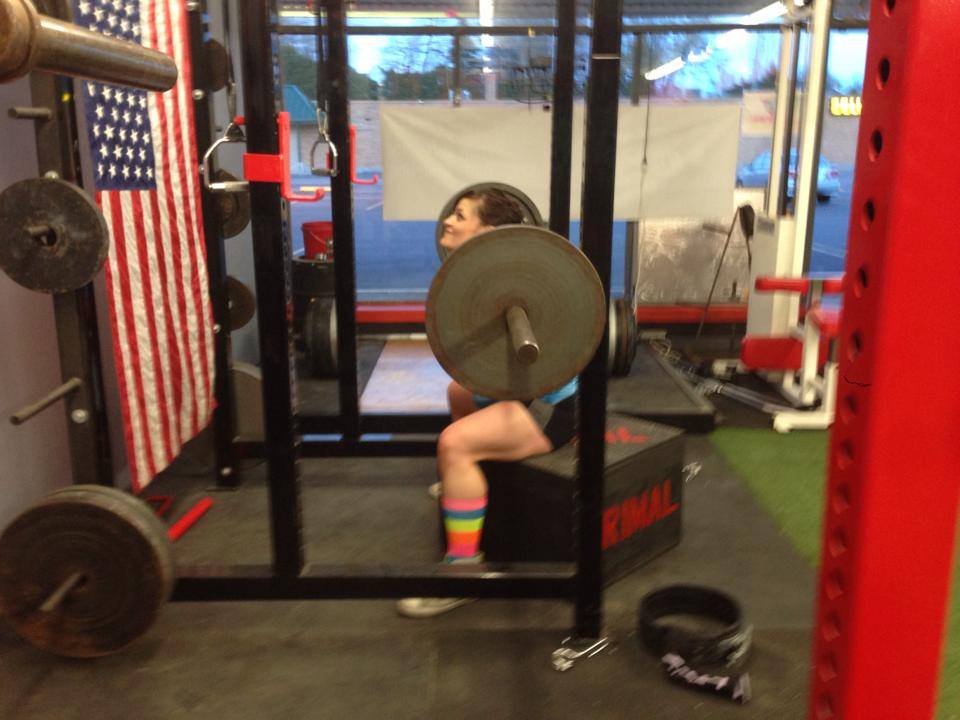 er of strength training programs to get you started on your journey to a leaner, stronger, healthier you!


 Print recipe
Recent Comments