
by EM2WL | Feb 26, 2012 | Building Muscle, Fat Loss / Cutting, Fitness Cycles (Periodization)
 Q: So I’ve been tossing around the idea of bulking to build muscle, and it’s got my mind spinning, lol.. That just seems crazy. Not there mentally yet… I have lost SO much weight, and the thought of putting on more just doesn’t sit right w/me yet, I guess. I know that you believe that you have to build muscle before you can cut/define it, but I honestly beg to differ, as I’ve never “bulked” and I know I see muscles. I’ve been doing most of the other things that you usually talk about: not starving myself (1800+ cals for deficit), lifting really heavy, moderate cardio here and there. And, because I’m still in a slight deficit, the scale keeps going down!
But most of all, I have gained so much definition…I would hate to lose what I have by going into a bulk…I am starting to get a headache with trying to figure out what I need to be doing. My goal is not so much the weight loss, as it is fitting back into my size 4 and looking toned, you know. I am almost there…I got on my smallest 6’s so I know I am a hair away from my 4 slacks…at that point, I just want to be cut you know what I mean. So, is there a loophole in your “eat at surplus to gain muscle” argument, or am I missing something/the exception to the rule?
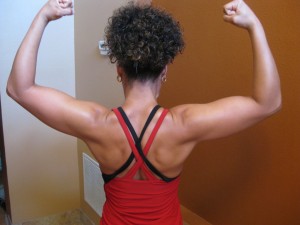
Cutting w/higher cals + heavy lifting = amazing results
A: A bigger person actually carries a larger amount of muscle mass,* naturally (the bigger the person, the more muscle). This is due to the fact that regular everyday movements (i.e. getting up out of a chair, pushing yourself out of bed in the AM, picking up your child) are essentially strength training movements (squats, tricep press, deadlift/bicep curl) due to the extra mass on the frame adding “weight” to the movement. The problem is there also is an extremely high ratio of fat covering that muscle (as a person who has been “bulking” – eating at surplus/lifting in low reps with high weight– might develop some fat along with the muscle).
So because you started this journey at such a high weight, and have kept weight training in the mix, technically what you’ve been doing is “cutting.” You’re just doing it properly by eating right (1800 cals to lose is AWESOME, btw) and keeping heavy weight training involved. This is more ideal than the person that just slashes cals to the bare minimum, and ODs on cardio (who would plow through their muscle store a bit more quickly).
Keys to remember:
- to build muscle (aka bulk) = eat at slight surplus, lower the reps, up the weights, cardio optional
- to lose fat while maintaining/defining muscle (aka cut) = eat at a slight deficit, continuing to lift heavy, adding in cardio as needed
So what you’re doing now, is what I recommend for most people starting from a much higher weight. Eating just under maintenance, but still lifting heavy and consistently (cutting) until getting down to a more comfortable weight range (or until newbie gains cease), before beginning bulk/cut cycles. The exception to this is if a person has gone into starvation mode from starting this path on a “biggest loser” mission (hours of cardio/huge calorie deficit), and has hit a plateau. I would recommend that person to do a metabolism reset/mini bulk before resuming cutting at much a slower rate (less cardio/higher cals than before).
You’ll know when the time comes to bulk, when you’ve ceased getting any beginner gains. But, as long as you’re getting the definition, etc that you seek, you’re fine. It’s hard to describe until it happens, but you just know.
The exception to this, would be the completely sedentary obese person, who, do to non-movement has experienced extreme muscle atrophy.
by EM2WL | Feb 26, 2012 | Building Muscle, Fitness Cycles (Periodization), Metabolism Reset, Q & A
Q: I’ve been spending a lot of time reading and thinking through my strategy…starting to really think about doing a metabolism reset or bulk, and cutting the cardio back. Then I start to question myself…like maybe I’m too heavy to start this process and am not at my weight loss goal. But, I really want to get the max benefit from my weight training. I’m OK with gaining a few lbs if the long-term result is good, but a little freaked out. I still am a ways from my weight loss goal. 20 to 30 lbs for sure. What do you think?
A: You’re honestly fine either way. I’ve actually had a couple people ask, so I’m gonna post what I said to the last person in the blog, because I think a lot of people are at a similar fork in the road. Of course each person has reached the road using slightly different methods, so the answer is kinda based on that…
- If someone has been pretty sensible about it from the start, I usually tell them it’s OK to get down to their weight loss goal weight before starting bulk/cut cycles. But if not, I’ll usually recommend a metabolism reset, or at least maintenance eating for a while, while things straighten themselves out, before going back to the deficit.

- If you know that you’ve participated in a little abuse to your body somewhere in there, then you may wanna give yourself a “time out.” Eat at maintenance or more for a while, and get all other things (cardio craziness, 1200 cals, anyone?) outta your system and under control before going back to a more sensible deficit/cut cycle. The time out can be uses as a “mini” bulk period, to give your body a purpose for the extra cals.
Ultimately the choice is yours, depending on what you’re mentally ready for. You really have to be mentally steady for doing a bulk or a reset. The benefits are numerous, but if you’re not ready, you’ll head for the hills before sticking around long enough to find out what they are.
by EM2WL | Feb 19, 2012 | Building Muscle, Fitness Cycles (Periodization), Increasing calories, Metabolism Reset, Q & A
Q: Seems like more and more people are “bulking,” I guess I’m wondering if I’m missing out on some hidden benefit of it. I get that it helps to put on muscle (muscle building), but I don’t think I would ever see the need for it in my life. What is the point of bulking? It almost seems like another yo-yo dieting trap. I mean, I guess I understand for a person that’s skinny, or at goal weight, but I’m a lot farther away from my goal than I’d like to be, and can’t imagine purposely putting on extra weight. What type of person (other than a bodybuilder, lol) should consider bulking or muscle building?
A: Bulking (eating above maintenance, while lifting heavy weights) can be beneficial to a variety of people, not just the skinny ones, lol. When I first began my “bulk/cut” cycles, I wasn’t at goal weight either (although I’d be the first to admit, that it may have been a lot easier if I was). But, learning the the benefits of it, and reaching a certain point in my weight loss, I decided to go ahead and go for it, for several reasons:
- The most obvious benefit is to add muscle mass, since muscle building cannot take place in a caloric deficit.

- Eating in a caloric deficit for a long period of time, or doing excessive cardio can begin to eat away at precious muscle mass – doing an occasional bulk, can help to rebuild any lost muscle.
- Long term deficit eating can also lower BMR, eating more will help to raise it, as will adding more muscle. Most people come out of a bulk being able to lose weight at a higher cal level than they previously did, as their maintenance level has increased. (The longer the bulk, the more our body adjusts to higher cal levels = higher BMR…The longer the deficit, the more our bodies adjust to lower cal levels = lower BMR)
- Bulking, or even just eating at maintenance, allows the mind and body to recover from the stresses of deficit eating, and gives a mental break to the person who has been dieting for a while.
Bulking can help whether you’re planning on competing in a fitness competition, want to look muscular/”ripped” when you get to your goal weight, have reached a plateau, or just want to increase your metabolism. Many people get burned out or reach plateaus after eating in a deficit for a long time. They reach a point where nothing is working, they can no longer safely reduce cals, or maybe they are just tired of surviving on so little cals. This is when a metabolism reset is usually done: where a person has to increase their cals, and stay there for a while, until the body readjusts to the higher cal level (thus, creating a new maintenance). Then they can start to lose at a higher cal level. Using this time to also bulk (add muscle while eating in the surplus) can make it a bit more purposeful for the person, rather than just eating more with no other goals (which can be a tough mental battle for a person who is trying to lose weight). It gives a new goal, to take the person’s mind off of “I’m trying to gain weight on purpose, am I insane?!” and gives those extra calories a job to do: build muscle. The building of muscle will also increase the ones metabolism, as the muscle continues to burn cals long after the reset has ended. Thus making the metabolism reset process dual purpose, and a little easier to stick to.
So a person that is not at goal weight can do smaller “mini” bulks along the way to help keep metabolism raised, and to add a little more muscle insurance to what will be seen as the fat is melted away (most women notoriously under-estimate the amount of muscle they carry). Bulking can also be used for the person that is reaching/at goal weight, but not getting the “cut” that they thought they’d have at goal. Since we can’t cut what isn’t there, this usually means that there is not enough muscle there to “tone.” Bulk/cut cycles allows the opportunity to build the muscle, then go back to “cutting,” repeating until the desired result is reached. For all parties involved, bulking can give that added benefit of a higher metabolism and maintenance level cals.
Q: So…it is like yo-yoing? I just can’t imagine purposely putting weight back on, when I’ve worked this hard to get it off! I just can’t wrap my head around this. It sounds crazy..
A: I would not recommend bulking to anyone that is not ready for it mentally, the same way I would not recommend it to an obese person (unless, they’ve been under-eating for a while & have gone into starvation mode, in which case a serious metabolism reset is needed). I always tell people that when it’s time to bulk, you’ll just “know.” It’s hard to describe it any other way. Just know what the benefits are, and give yourself enough time to grasp it mentally before diving in. The results are definitely well worth it, but you have to know why you’re doing it and what you’re in for. Bulk/cut is not like yo-yoing, because the “gain” part of yo-yoing is usually unplanned and out of control. The bulking process is planned, you give yourself boundaries, and because you’re adding muscle to your frame, the weight comes on in completely different proportions. Your body comes out looking better after every cut cycle, and you’re not killing yourself to get results that will just go by the wayside as soon as you eat “normal” again, due to the increased metabolism. A bulk is not about packing on the pounds, it is about packing on the muscle. Every move is planned, as precise as you allow it to be, and, when done with incredible precision, fat gain is minimal. Yo-yoing, usually leaves you in worse shape after each “round.” Bulk/cut is quite the opposite.
by EM2WL | Feb 7, 2012 | Metabolism Reset
Q: I feel perfectly fine eating at 1250 cals. The weight is coming off, I’m happy w/my progress, and I don’t feel “starved” at all. I hear you and others saying a lot about the body going into “starvation mode” or their metabolism being “damaged” by eating less, so they get stuck there. I guess I understand all that, but I’m just wondering if that even applies to me, since I’m perfectly happy w/the way things are. Even if I get “stuck” at this cal level, I mean, I’m already used to it anyway. What’s the big deal? And where does the whole “starvation mode” concept come from? Is there really backing to that, or just one of those things that got tossed around enough until it became fact? I just don’t get into following trends, and “eat less/workout more” has been around forever, and is tried and true…..
A: Instead of tossing all of usual shenanigans at you on how if you hit a plateau, you’ll have to lower cals even further, blah blah, I’ll leave that ramble for another time (since you’ve heard it all before anyway, I typically don’t say anything “new” lol). What I am gonna do is address your most pressing part of that question (which is an EXCELLENT question, btw) by telling you a story. Then, as the disclaimer usually goes, the rest is up to you to do what you feel is best for your body….
Based on a true story…
 It was called the Minnesota Experiment. In the 1940s, during WWII, there was widespread famine in Europe. During that time, there were men who did not enter the draft for whatever religious or other reasons, who volunteered to participate in a study to do their part to help. The study’s

recruitment ad read something like “Will you starve, so that they don’t have to?” The study was to help us to understand what happened to humans under the circumstances of being food deprived, yet having to continue on w/everyday activities. The results were published in a two-volume study titled the The Biology of Human Starvation (Minneapolis: University of Minnesota Press, 1950). There has never been, and never will be a study done like it again, and you will see why…
During this study, 40 able bodied, well-educated, socialized, and healthy men were put on a caloric restrictive diet that would resemble that of the countries being hit hard by the war. This diet was set up to have them lose 25% of their body weight, approximately 2.5 lbs per week. Daily exercise consisted of walking 3 miles/day. They all ate only twice a day. The diet would take approximately 3 months to complete, and would then be followed by a 3 month rehabilitation, where they took their calories back up to maintenance, following specific nutritional guidelines (as far as their vitamin/mineral contents, etc). Results were closely monitored & chronicled during the 6 months of the experiment, and up to a year after resuming to their normal lives/eating habits.
Some of the results found during their weight loss period:
- their physical endurance dropped by half
- their strength was reduced by about 10%, and their reflexes became sluggish — with the men initially the most fit showing the greatest deterioration
- heart volume shrank about 20%
- their pulses slowed and body temperatures dropped
- complaints of feeling cold, tired and hungry; having trouble concentrating; of impaired judgment and comprehension; dizzy spells; visual disturbances; ringing in their ears; tingling and numbing of their extremities; stomach aches, body aches and headaches; trouble sleeping; hair thinning; and their skin growing dry and thin.
- sexual function and testes size were reduced and they lost all interest in sex (we’re talking about men, here…that’s a pretty big deal).
They had every physical indication of accelerated aging.
- became nervous, anxious, apathetic, withdrawn, impatient, self-critical with distorted body images and even feeling overweight, moody, emotional and depressed
- social and family relationships suffered
- They became obsessed with food, thinking, talking and reading about it constantly; developed weird eating rituals; began hoarding things; consumed vast amounts of coffee and tea; and chewed gum incessantly (as many as 40 packages a day). Binge eating episodes also became a problem as some of the men were unable to continue to restrict their eating in their hunger.
(Whew, I almost feel like somebody followed me around documenting my dieting days when I read those last few….)
Upon returning to their normal eating habits, the men seemed to have out of control eating, feeling like they could never get enough. It took many of them five months or more before things finally begin to level out (metabolism/energy levels) and they 

started to regain normalcy to their eating (though some continued to have an eating disorder frame of mind when it came to the food, for even longer). Strength levels took more than three months to return to normal. The studies found that the men needed to over eat in order for this rehabilitation to take place, because the body had been in such short supply of nutrients needed, it essentially needed an “over-dose” for months, in order to get it back to normal. In lieu of the over eating then men had to gain 10% more than their original weight back, but the weight came back in different proportions. The regained weight was mostly fat, and their lean body mass recovered at an extremely slower pace. With unlimited food and unrestricted eating, their weights plateaued and finally, about 9 months later, most had naturally returned to their initial weights without trying.
Dr Keys (who performed the study) concluded this regarding why the “over-eating” was a necessary evil in BMR rehabilitation:
“Our experiments have shown that in an adult man, no appreciable rehabilitation can take place on a diet of 2,000 calories a day. The proper level is more like 4,000 kcal daily for some months. The character of the rehabilitation diet is important also, but unless calories are abundant, then extra proteins, vitamins and minerals are of little value.” (<<<emphasis, mine)
So essentially, these men had to eat double the amount of food to make up for the newly deemed “starvation mode” that they’d just subjected their bodies to. And note that they needed FOOD, supplementation alone, without the extra calories, was not enough to rebuild their BMR. Of course the study goes much deeper than that, (as I said it was a two-volume study) but I’m just pulling on the gist of it to give background on where the “starvation mode” theory came from.
So…..what does this have to do with us now? We live in America, after all, one of the richest, well fed countries in the world. There is no way that we would “starve” ourselves to that extent, even on the lowest calorie diets, right? Just how little were these guys eating?
1570 calories/day*
That’s a pretty generous allowance, by today’s standards, eh?
*they were only allowed 30g of fat intake, daily, which again shows the importance of keeping essential fats in your eating regimen, even when “dieting”
For more information on this super-intriguing study (at least to me) feel free to just google “The Minnesota Experiment” or “Minnesota Experiment Sam Legg” (google images if you’re interested in a pic of one of the men) or read The Biology of Human Starvation (if you’re really a research geek, like me)
ETA: Many people have commented about the fact that these were “healthy and fit men,” and that “people were a lot more active ‘in those days.’ ” However, we need to remember that this phrase speaks also of their mental health (as it was also under observation), and they were healthy and fit for men at that point in time. The Industrial Revolution had already come and gone, and people in general, were already a lot less active than previous generations. Let’s not assume that they were out on farms somewhere working up a sweat. The study stated that their exercise plan was a 3 mile walk/daily. Nothing strenuous. It is also worth noting that (in our time) a person that is up to 30 lbs heavier than they would like to be can be declared “healthy and fit” by their doctor. Go to any “healthy body weight calculator” and see the wide range of weight that is considered in the “healthy” range for that persons height. This does not mean that the person will not want to lose weight, even though they are “healthy”.
ETA (2): It is also worth noting that although these men all lost weight originally, they ALL plateaued by the 20th week w/no further weight loss for the duration of the study. As I stated, please do yourself a favor and research it for more in depth info, this was just a truncated version for this particular question of “where did the concept come from?’ The research is out there, but diet plans are the mainstream, so you have to search for anything outside of the box.

by EM2WL | Feb 6, 2012 | Cardio, Fat Loss / Cutting
Q: Why do you hate cardio so much? Cardio is good for you isn’t it? But yet it always seems like you’re telling people to “stop doing too much cardio,” or talking about how much you hate it. I’m almost scared to even say that I did cardio around you, because you make it seem like a bad thing…I love cardio, it keeps me sane, keeps my heart healthy and my blood pressure low, and keeps the weight off. So…what’s so bad about it?

What’s so bad about cardio?
A: First, I want to say that if I’ve made you feel bad about doing cardio around me, I’m sorry. I never set out to be the “cardio police” lol, and I would never want to make you feel bad about doing something that you truly enjoy. Typically when you see me making a comment about someone doing “too much cardio,” it’s because that person and I have usually talked privately about them wanting to build/preserve muscle. Usually it’s also a person that I know/knows me well enough to know that I, personally, don’t love cardio.
It’s also usually:
- said in a joking manner,
- said because they’ve asked my opinion, and I’m giving it,
- they despise cardio, but are doing a ton because they think they need to,
- they’re wondering why they’re not packing on the muscle despite the time they’re putting in with the iron, or
- they are eating in a deficit, and NOT eating back their exercise calories.
Cardio, in and of itself is not the devil. I have a soft-spot in my own heart for cardio (especially kickboxing…LOVE!), being that it is what helped me to shed my first pounds and develop an interest in fitness. Also, I suffer from endometriosis, and very poor circulation (due to a developmental issue in my childhood that left me with a much lower red blood cell count than most individuals over the age of two), and keeping a certain cardiovascular level helps me to minimize the effect that those health issues have on my quality of life (while also setting limitations on how much cardio I am physically able to do).
I also choose to keep cardio in my muscle building phase, though many exclude it altogether (in effort to gain as much muscle as possible, while sacrificing none). Cardio can be quite beneficial in the muscle building phase, when done in between weight training days, as a “recovery” workout of sorts. Aerobic (literally meaning “with oxygen”) exercise, aids in muscle recovery by sending oxygen into the very muscles that were worked the day before. This also helps in flushing any remaining lactic acid in the muscle that helps many to cope with the DOMS (delayed onset muscle soreness) that they feel the day after an intense weight workout.

Whoa! Kiki caught ENJOYING cardio?
So… what’s my problem with cardio? The reason that I seem to disapprove when someone is doing cardio is because most people don’t eat enough to fuel their cardio workouts. They are using cardio to come up with an extreme caloric deficit. Basically, many people try to go about it Biggest Loser style. Not that I’m knocking the show (well…maybe I am), as it is very inspirational to see people who WANT to change their lives, and get rid of unhealthy habits. The problem with the mentality that it can leave us with, is that we start thinking that if we workout six hours a day, we can lose 5-10 pounds every week, getting this weight off as quickly as possible. We have to keep in mind that when it comes to weight loss: slow is better, and means that you’re more likely to keep the weight off. Just as the show only lasts for 12-16 weeks, that type of lifestyle cannot carry on forever.
Many professionals (i.e. bodybuilders, fitness models, actors, etc) will sometimes use the more cardio/less food approach as they prepare for a specific event/role, but, again, we are looking at shorter durations of time (at the most intense level), and often they still go about it quite slowly. Bodybuilders will also often go through a period of “reverse dieting” (increasing food intake, even if it results in an initial gain) in order to reset their metabolism once the show is over. Regular folk, however, tend to just stay on that track for much longer than necessary, as their body begins to require the higher levels of cardio and less food scenario. It’s an extremely slippery slope.

Strength training doubles your fat loss efforts!
Most people that I’ve talked to privately, who’ve asked my opinion on their cardio sessions can attest to the fact that I ultimately always arrive at the same response, regardless of my personal feelings toward cardio, and my “anti-cardio” facade:
“If you want to do the cardio, do it…if you don’t, don’t”
Yes, there are ways to lose weight without cardio. Yes, you can even “cut” without cardio if you wanted. Yes, technically, there are ways to build/keep muscle while still doing cardio, even if takes longer or seems harder (especially in hard gainers like women or ectomorph type), with enough attention to detail, if a cardio junkie can’t let go, or a marathon runner really want’s to counteract the muscle they’re catabolizing during their races, it can be done. You still need to follow the basic principle of eating at a surplus (including eating back your exercise cals!), lifting heavy, and taking in enough protein to support muscle growth. You may end up having to work twice as hard, just to build the same amount (or less) of muscle, but hey, if you can’t live without it, you can’t live without it.
So the question then becomes: are you doing cardio because you can’t live without it, or are you giving yourself extra work because you think you have to? (remember, we’re talking about doing cardio in excessive quantities/lengths here, not your basic 30 min cardio session). Cardio-haters are usually pleasantly surprised/thrilled at the fact that they don’t need to kill themselves on the treadmill in order to get results, and eager to learn more. But the fact remains that you need to be aware of the fact doing excessive cardio, while trying to build muscle can send your body mixed messages, so watch for key signs of over doing it. If you begin to notice muscle loss, lack of progress, not being able to go as heavy on your lifts, etc., it’s typically a classic sign that you are under-eating, doing “too much” cardio, or both. But don’t expect to do a little weight lifting, TONS of cardio, eat at a deficit, and be muscular and “ripped”…unless you just spent the last year in a serious bulk (i.e. eating at surplus, and lifting heavy three or more days per week)
Sorry, can’t “rip” what isn’t there, yet :-/
~~~~~~~~~~~~~
Disclaimer time: For me (Kiki), I find that it’s much easier to just focus on my lifts and do minimal amounts of cardio (2, sometimes 3x’s a week – to keep a cardiovascular fitness level), while either a) eating in a surplus when building muscle, or b) eating in a deficit while leaning out. I do tend to do more cardio in the warmer months, as I’m naturally more active (family bike rides, basketball, gardening, etc), so if my cals are set at a deficit during that time, I am careful to eat back any exercise cals.



Recent Comments