

Compound vs Isolation Exercises
If you are new to strength training, you may be confused by some of the terms that get thrown around. Questions that we frequently get asked is about the difference between compound vs isolation exercises.
- What is the difference between compound and isolation movements?
- Are compound or isolation exercises preferred?
- When should I incorporate these movements into my strength training regimen?
In general, compound exercises are those weighted movements that involve multiple major muscle groups and involve movement at multiple joints of the body. Generally speaking, they promote “functional fitness” by simulating real life activities. Examples of compound exercises would be the squat, the deadlift, the row, and the bench press. There are multiple versions of each of these exercises.
 In contrast, isolation exercises generally work only one muscle group and involve movement at only one joint. Often, isolation exercises are performed on machines. Typical examples include the biceps curl or the quadriceps extension.
A prime example of a compound exercise is the deadlift. Although many people think of the deadlift as a lower body exercise, a number of other muscles are used as stabilizer muscles in this exercise. The biceps, abdominal muscles, and trapezius are a few of the upper body muscles which are targeted. Deadlifts are a prime example of one exercise working nearly every muscle fiber in the body!
Compound Movements have a number of benefits:
- Because more muscle fibers from large muscle groups are being recruited, these movements burn more calories
- Are often seen as a more effective use of time, since a full body workout can be completed with only a few exercises.
- Mimic movements that are used in daily life, thereby enhancing functional fitness.
- Provide cardiovascular conditioning and benefits
- Provide sport-specific benefits such as improved mobility, coordination and balance
- Trigger greater release of muscle-building hormones
- Reduce risk of over-training since fewer training sessions are required to target muscle groups
If your primary goal is fat loss, doing moderate to high repetitions of compound movements will provide a great calorie burn and target your large muscle groups, thereby stimulating the metabolism. It should be stressed that compound movements do prevent a greater risk for injury if done incorrectly. Learning proper form should be a major consideration. If you have access to a personal trainer or someone who is an experienced lifter, perhaps ask them to demonstrate proper form or watch your lifts. Another good idea is to video your lifts and check your form. If you are very new to lifting, checking out examples of exercises on YouTube is a great idea.
For those seeking to gain muscle or increase strength, heavy compound movements in the lower repetition range (3-8) will provide an environment for this as well. However, both those seeking to lose fat or gain muscle will benefit from including some isolation exercises.
Benefits of Isolation Movements:
- reduces risk of injury -increases blood volume to muscle
- initiates growth
- correct imbalances which may result from or lead to injury
- increases size and bulk of muscle, and provide shape to the muscle
After fast-twitch muscle fibers have been depleted through heavy compound work, isolation exercises can be used to maximize blood volume to the muscle, thereby initiating the growth process.

Heavy Lifting Makes us happy!
If you are new to strength training, you will probably want to structure your program around some good, basic compound exercises such as the bench press, row, deadlift and squat. Start light, learn proper form, and gradually increase the weight being lifted. Generally speaking, a well-structured lifting program will focus on compound movements first and then add in complementary isolation exercises to correct imbalances and provide an opportunity for hypertrophy. Even beginners will benefit from adding in some isolation exercises to their strength training program. These exercises should be ones that are directly related to the compound lifts.
Below are some examples of isolation exercises that will have the most carryover to your main lifts.
Bench Press
- triceps extensions
- front raises
- side raises
- rope pull downs
Deadlifts
- bicep curls
- hip thrusts
- leg extensions
- glute ham raise
Squats
- leg extensions
- reverse hyper
- leg curls Rows-bicep curls
For the majority of people looking to lose fat, gain muscle and improve functional fitness, a well rounded lifting program will focus first on compound lifts and then add in isolation movements to increase hypertrophy, prevent injury, and correct imbalances. Using both compound and isolation exercises will get you the results you are seeking! The following example should provide a good idea of how to combine both compound and isolation exercises for an effective workout that will provide an environment for building muscle, burning fat, and increasing strength and overall conditioning. These workouts should be able to be completed in about an hour. For best results, find a weight that challenges you. If you can complete more than the prescribed number of repetitions, you will want to increase the weight.
Monday: Legs and Glutes
| Barbell Squats | 5 sets | 8 repetitions |
| Lunges (either barbell or dumbbell) | 3 sets | 8 repetitions |
| Glute Ham Raise | 4 sets | 10-12 repetitions |
| Leg Extension | 3 sets | 10-12 repetitions |
Wednesday: Upper Body
| Bench Press | 5 sets | 8 repetitions/set |
| Bent-over Barbell Row | 3 sets | 8 repetitions/set |
| Standing Military Press | 3 sets | 8 repetitions/set |
| Superset:Triceps pushdown lateral raises | 3 sets | 10 repetitions/set |
Friday: Legs and Back
| Deadlifts | 5 sets | 8 repetitions |
| Front Squats | 3 sets | 8 repetitions |
| Lat Pulldowns | 4 sets | 12 repetitions |
| Barbell Biceps Curl | 3 sets | 10 repetitions |
Becca is a busy wife and homeschooling mother to five children ages 5 to 13. About three years ago, she embarked on a journey to health and fitness that resulted in the loss of approximately 100 pounds. Today, she is a competitive powerlifter and strongwoman who loves ice cream and deadlifts. As an ISSA certified personal trainer, she is passionate about helping women to get started on a lifestyle of strength and fitness.
 How to Pick a Personal Trainer…
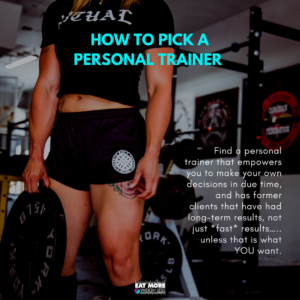 Another way a personal trainer can make that impact, is by telling you that your current cal intake (whatever it may be) is too high. This lowering of cals is almost a guaranteed drop in lbs within the first week or so, simply because the cals were high(er), and now they’re not. Having such a significant drop in lbs within the first week or so will buy the trainer MUCH more time with that client, because they have earned their trust. If they can quickly get you to drop weight, then long after you’ve stopped going to them, and gained the weight back, (because you’ve gone back to eating normal, and working out in your regular manner) you’ll always remember how you had “better” results when you worked with them. You’ll go back (at your higher cal intake) they will have you drop calories (again), while kicking your butt with the workouts. So as long as you stay with them, and dependent on them, you both “win.”
 Although it’s harder to look a client in the eye and tell them to do the opposite of everything that they’ve read, and that they shouldn’t expect any results from working with me for at least the first month, it sets the standard for our relationship right off the bat. I let them know that I will not withhold any “secrets” from them in what they need to reach their goals,
Recent Comments